For API GET call, not receiving item type in the payload for custom part.
Hi, We have following scenario, If I do a get call for Part or Requirement, I'm receiving the respective item-types id as 'itemtype':'id' in payload. But if I do get call for a custom Item I'm not receiving the 'itemtype':'id' in its payload. If I have to get the 'itemtype':'id' for a custom item, do I need to update my item type or my API call? Below, I have added API calls and responses for different items. Get Call for Requirement: instance/Server/odata/re_Requirement('D2E185A3F91248CEB219C848C56EC97C')?$expand= Payload: { "@odata.context": "instance/Server/odata/$metadata#re_Requirement/$entity", "classification": "Requirement", "content": "<Requirement aras:id=\"4c2ebcb8a3d544769f42e1238ddb0b55\" reqId=\"70F10587B45F4B7DB612CD2455089234\" xmlns:aras=\"http://aras.com/ArasTechDoc\" xmlns=\"http://www.aras.com/REStandard\"><Requirement-Info aras:id=\"1e9e767cf6d24c838d902d3e1e3e5c65\"><Requirement-Chapter aras:id=\"d1c3cc1e37954198b01ad944bfb74150\"><aras:emph emphtype=\"text\"></aras:emph></Requirement-Chapter><Requirement-Title aras:id=\"7b86d25939b248d99aa3fc6a27aac6ff\"><aras:emph emphtype=\"text\">Asot Req 1</aras:emph></Requirement-Title><Requirement-Number aras:id=\"fe249c8cbe1f4926843bcc65703fa948\"><aras:emph emphtype=\"text\">REQ-000000272</aras:emph></Requirement-Number></Requirement-Info><Text aras:id=\"27be607cf9014ff591071e5a4b62a1e6\" /></Requirement>", "[email protected]": "en", "created_on": "2026-01-14T07:01:01", "[email protected]": "Draft", "generation": 2, "global_version": "32007", "id": "D2E185A3F91248CEB219C848C56EC97C", "is_current": "1", "is_released": "0", "keyed_name": "REQ-000000272 Asot Req 1", "major_rev": "A", "modified_on": "2026-01-19T07:39:05", "new_version": "0", "not_lockable": "0", "req_complexity": "Low", "req_priority": "Low", "req_risk": "Low", "root_element_name": "Requirement", "root_element_type": "Single", "state": "Draft", "item_number": "REQ-000000272", "req_title": "Asot Req 1", "itemtype": "55515617CB224C90AB5A9DAC0F061C2A" } Get Call for Custom Item: instance/Server/odata/poc_ASOT_Item('EE714F53C7D8438990900B58658C5763')?$expand= Payload: { "@odata.context": "instance/Server/odata/$metadata#poc_ASOT_Item/$entity", "created_on": "2026-01-19T13:57:35", "generation": 1, "id": "EE714F53C7D8438990900B58658C5763", "is_current": "1", "is_released": "0", "keyed_name": "ASOT_00086", "major_rev": "A", "modified_on": "2026-01-19T13:57:35", "new_version": "1", "not_lockable": "0", "poc_channel_name": "234", "poc_datasource": "DOORS_SOURCE_1", "poc_datasourcetype": "DOORS", "poc_displayname": "xyz", "poc_fqn": "rr33ee55", "poc_item_number": "ASOT_00086" } Do you know how to do this? Thanks in advance. Best regards TanjumSolved128Views0likes2Comments
Can Assembly has different version of BOM?
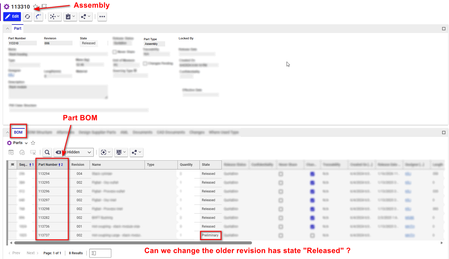
Hi, We have following scenario, I have one Part assembly, and has 8 Part BOM as shown below. Can we change the Part BOM to older revision that has state "Released". Note: Here Part assembly is in "Released" state and locked for updating. We can promote assembly to "Manual Change" state but related Part BOM got unlocked and got synced to their latest revision, which we do not want. Is there any way were we can change the few property of the Part assembly without unlocking the Part BOM? (We do not want to sync the revision of PART BOM if it has higher revisions.) Thanks in Advance !!187Views0likes2Comments
Batch Delete Identity Memberships
Hello, We have used the batchloader utility to create new memberships in Innovator. It appears that removals are a bit more difficult due to safeguards in place for the system. What is an easy path forward in creating an AML script (or method) to accomplish this task? For example, we have 89 identities that had incorrect identity membership assignments. The goal is to remove existing memberships of an identity and add a different identity. --CorbinSolved185Views0likes2Comments
How does Aras handle the action(s) on a collection of items in an AML?
I have written a server method that uses some custom XML-like AML to implement an inventory reconciliation. I would like to pass in a collection of items for this method to act on. When I implement a server call like: <AML> <Item type="Part" id="1" action="mymethod"/> <Item type="Part" id="2" ./> </AML> is "this" the collection? Or is the correct approach to pass the collection within an item? <AML> <Item type="Part" id="x" action="mymethod"> <Item type="Part" id="1" ./> <Item type="Part" id="2" ./> </Item> </AML> Or, is it generally considered best practice to have the server method called independently for each item? Thank you!1.2KViews0likes1Comment
ARAS31 import.mf deployment issue
Hai, We recently upgraded our environment from Aras Innovator 11 to Aras Innovator 31, and we are running into several issues while deploying our solution packages. I wanted to share the details here to see if anyone has faced similar challenges or has suggestions. In Aras 11, we used an import.mf file with the following structure, and everything deployed without issues: <imports> <package name="DatabaseIdentifier" path="com\aras\innovator\DatabaseIdentifier" /> <package name="com.aras.innovator.solution.PLM" path="PLM\Import" /> <package name="com.aras.innovator.solution.Project" path="Project\Import"> <dependson name="com.aras.innovator.solution.PLM" /> </package> <package name="com.aras.innovator.core" path=".\" /> <package name="com.aras.innovator.cui_default" path=".\" /> <package name="Custom_Pkg1" path="CustomPkg1\Import" /> <package name="Custom_Pkg2" path="CustomPkg2\Import" /> </imports> After upgrading to Aras 31, we tried using the same .mf configuration, but we are encountering multiple deployment errors. Issues Observed 1. Null Reference Error Object reference not set to an instance of an object. 2. Method Not Found Error It points to this AML:→ Error: “No items of type Method found.” <Item type='ItemType' id='8052A558B9084D41B9F11805E464F443' action='edit'> <Relationships> <Item type="Server Event" action="add"> <related_id keyed_name="FileOnGet" type="Method"> <Item type="Method" action="get" select="id"> <name>FileOnGet</name> </Item> </related_id> </Item> </Relationships> </Item> Import package 'com.aras.innovator.core' failed with message: No items of type Method not found. 3. Timeout Error During Import The package was then marked as a failed release (seen for custom_Pkg). faultcode: 999 faultstring: System.Net.WebException: The operation has timed out 1. In Aras 31, are we required to use manifest.json instead of the old import.mf format for custom packages? 2. If yes, where exactly should the manifest.json file be placed, and what structure should it follow? 3. How should we handle customizations or extensions to system-level packages like com.aras.innovator.core and com.aras.innovator.cui_default that previously existed in Aras 11? 4. Has anyone encountered the faultcode 999 / timeout issue during import — and how did we resolve it? Thanks in Advance SaliniSolved313Views0likes9CommentsHTTP Error 500.19 - Internal Server Error
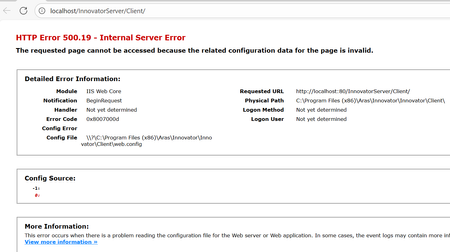
This error hits while installing the ARAS innovator, if User done install the .Net Hosting bundle. The solution was to download and install the MS .Net 8.0 Hosting bundle from below link. HTTP Error 500.19 after installing Innovator 2025 - Solved - Getting Started - Aras Community - Aras Community141Views0likes0Comments
How do you import Excel BOM data into Aras Innovator open version?
Hello, I currently use the open, free version of Aras Innovator and am having difficulty figuring out how to store BOM data within the tool. I have seen from other posts that subscribers have access to a direct import functionality and also some kind of batch loader. For the latest free version of ARAS, what are the exact steps to import an excel file containing BOM data into Aras? Any help would be greatly appreciated.6.4KViews1like7Comments
What does the "isCriteria" attribute do?
Hi Community, what is the purpose of the "isCriteria" attribute? It´s described in the programmers guide like this: "If 0 then include the nested structure for the Item configuration in the response but don't use it as search criteria. Default is 1, which uses the nested structure in the request as search criteria." I tested the attribute with an AML query with relationships. I even tested original Aras queries that use the attribute. I never noticed any difference in the query result. Does anyone know more?Solved176Views0likes2Comments
Item.apply overwriting action, has it always done this?
After upgrading from version 12 to 31, we started getting an error when saving a certain custom datastructure, developed for us by Minerva back in the day: Failed to execute 'serializeToString' on 'XMLSerializer': parameter 1 is not of type 'Node'. From what I can tell, this happens because Minerva's old code calls an action directly on the document.thisItem object var output = document.thisItem.apply("VE_GetCopyTreeGridHeader"); which "pollutes" document.thisItem with that action. When later hitting save, it calls this function instead of doing whatever it ordinarily would (probably a get action), resulting in the error. I observe that if I change the action to "get", it gets rid of the error message and saves any changes in the object itself, but not in a related items treegrid associated with it. If I change the Iaction to "update", it saves everything correctly the way it used to do in version 12. I see that the docs on item apply says that it overwrites the action, but if it always did that, how did this code ever work? (By the way, that .apply() overwrites the action is an error-prone side effect which I can't see any good reason for)66Views0likes1CommentNeed help with AML query to connect two independent ItemTypes via referencing item
Hi community, I am working on an AML query but cannot find a proper solution. It contains a lot of custom ItemTypes, but technically the query would work similar like this: START--------> Part ---------------------> Part BOM --------------------------> Part <------------- MyCustomItemType (part_id) <-------- GOAL is to get properties of this referencing item We start from Part and go downwards to get the complete BOM. Easy. Now I have a second independent ItemType "MyCustomItemType" that also uses Part inside an item property. I want to include this custom ItemType to the query to fetch some additional data. In my case the end result shall combine BOM information with warehouse specific data. Problem: "MyCustomItemType" is not included in the "natural downward path" of Parts. And I want to avoid to include it at all costs. The data is federated and shall only be fetched on demand. So we have only a true reference from "MyCustomItemType" to Part, but no real reference form "Part" to "MyCustomItemType". Question: How can I get the data of MyCustomItemType when we start from the top part? Is this possible at all? Interesting detail: When we use a Query Definition these kind of "inverted" queries would be possible by "using referencing item". Is something similar possible with plain AML? Thanks for any hint! Angela181Views0likes6Comments